> For the complete documentation index, see [llms.txt](https://docs.skyone.cloud/llms.txt). Markdown versions of documentation pages are available by appending `.md` to page URLs; this page is available as [Markdown](https://docs.skyone.cloud/english/skyone-studio/modules/settings-and-operations/module-settings/connectivity-file.md).
# Connectivity: File
### Overview
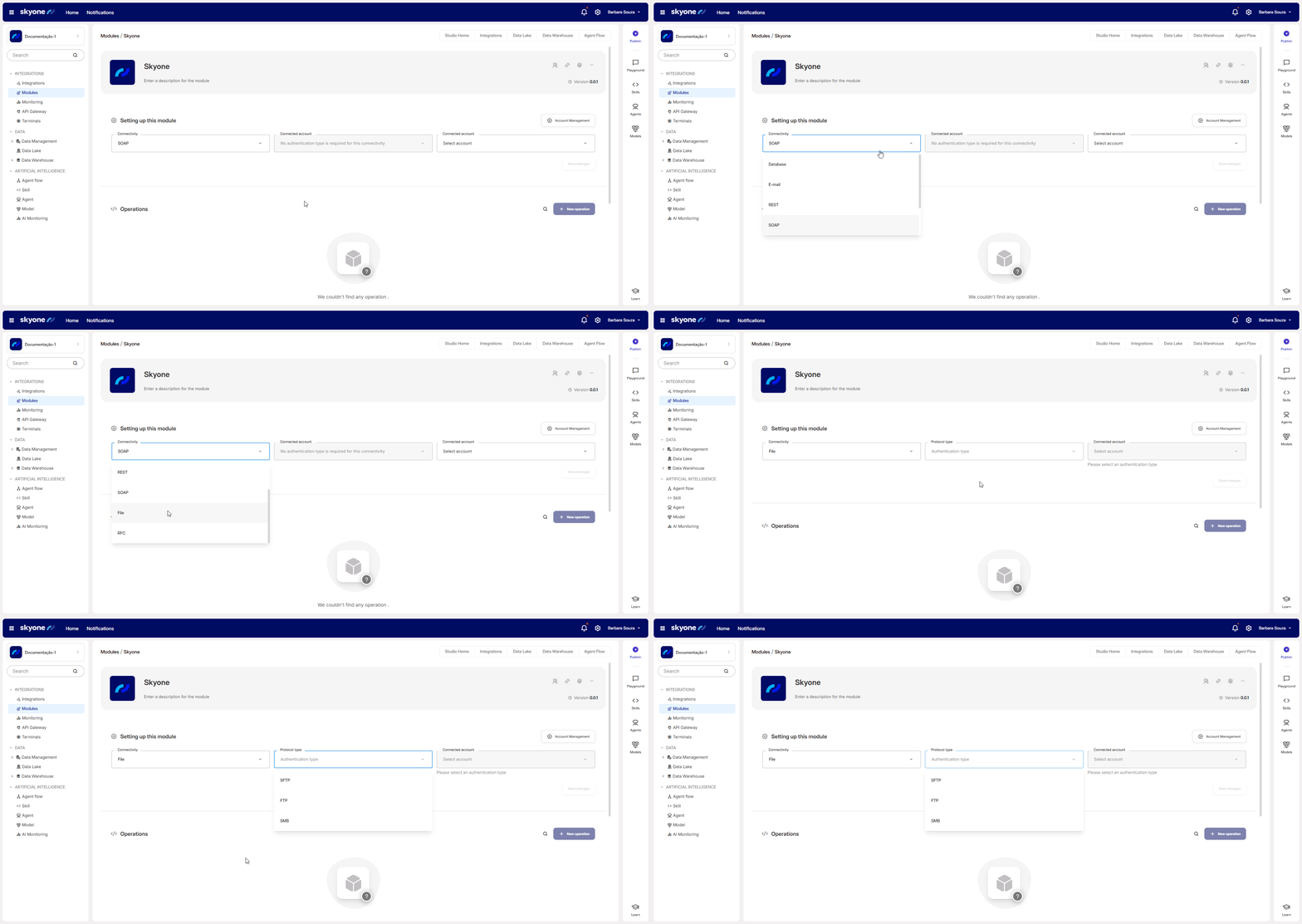
**File connectivity** allows the integration of file-based systems and data. For this type of connectivity, Skyone Studio supports the use of **SFTP**, **FTP**, and **SMB** protocols.
This connectivity is useful for reading various file formats, transforming data, and handling errors.
***
#### How to connect an account
After defining the type of connectivity, the next step is to choose the **type of authentication**, which in the case of File is **Protocol**. Only after these settings have been made will you be able to add a new account, as well as select, edit or remove one of the previously registered accounts.
Escolha um Tipo de Autenticação para liberar a opção de Conta Conectada
To add a connected account, click on "**Connected account"** and then "**Add connected account"**.
To continue with the configuration, click on the tab of the chosen **authentication type (Protocol)**:
{% tabs %}
{% tab title="SFTP" %}
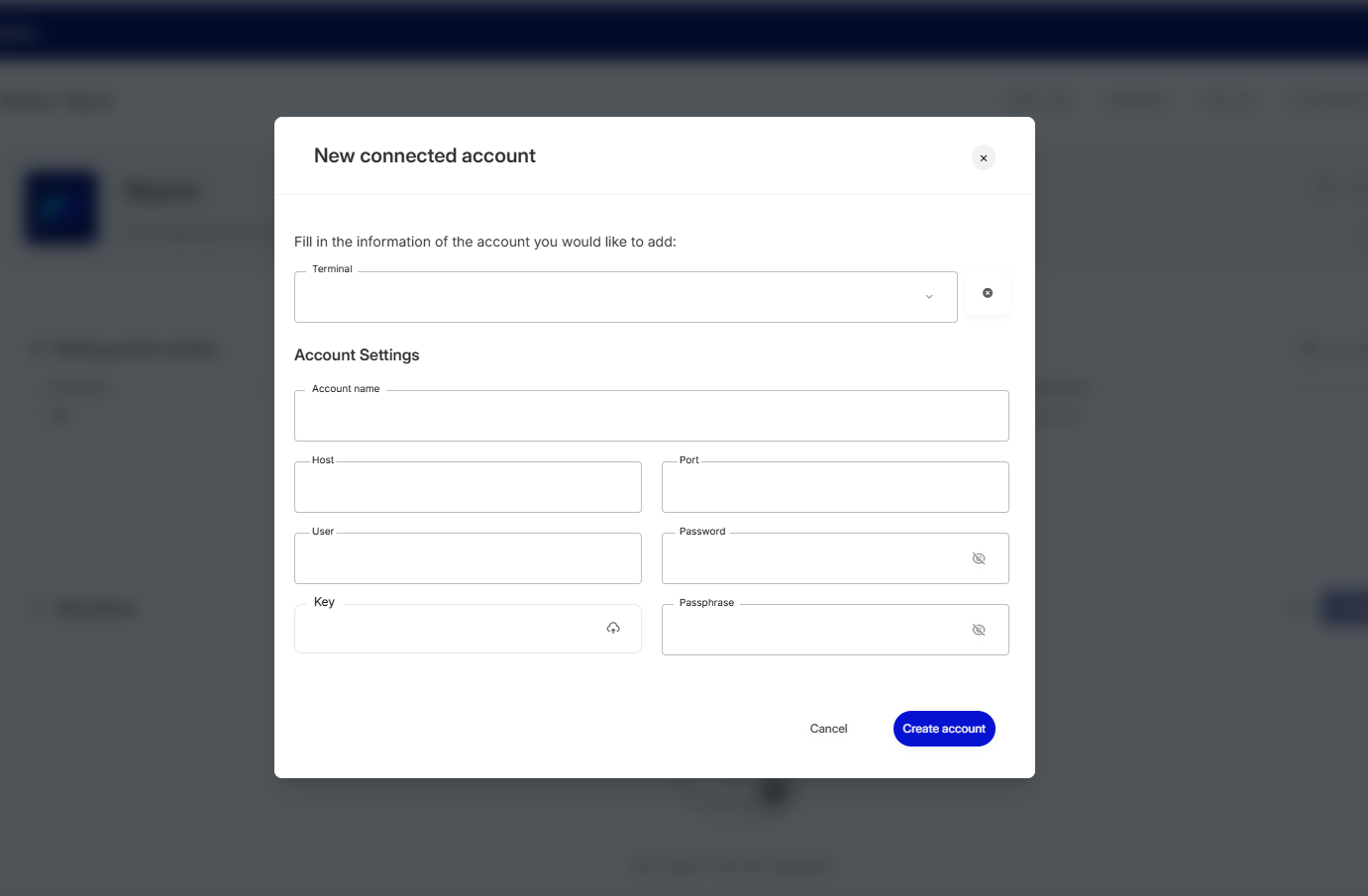
When you choose the "**Add connected account"** option, the following modal will be displayed:
Fill in the details:
1. **Terminal** (optional): if you have a terminal set up, select it so that the connection is made through the corresponding "**Agent"**;
2. **Account name**: name of the registered account;
3. **Host**: IP of the database host;
4. **Port**: port number;
5. **User**;
6. **Password**;
7. **Key:** Only files in PEM format are allowed;
8. **Passphrase**.
After filling in the details, click on "**Create account**".
That's it! Your connected account has been created and can be used by other modules and flows, appearing among the options of accounts configured in both cases.
{% endtab %}
{% tab title="FTP" %}
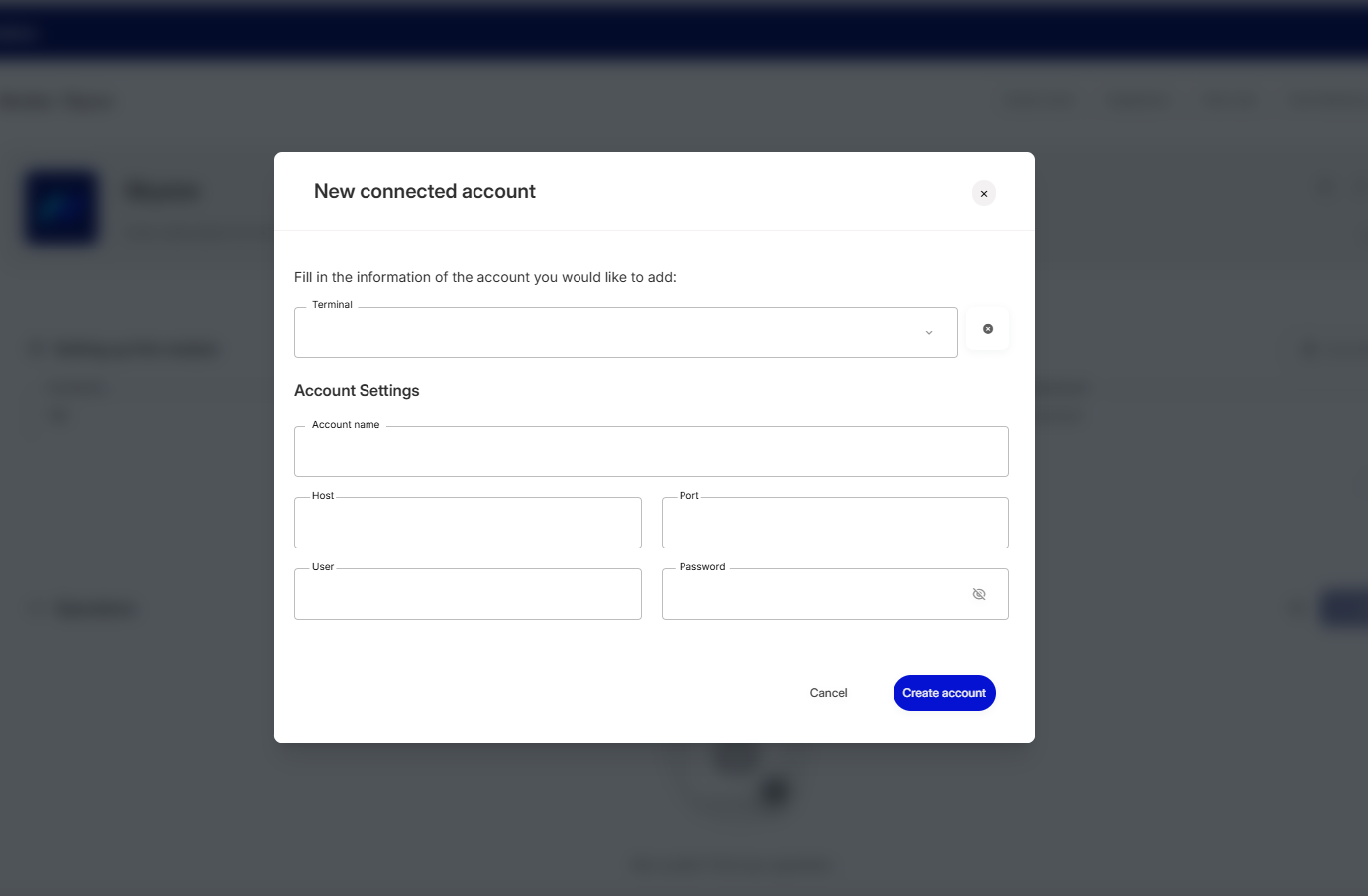
When you choose the "**Add connected account"** option, the following modal will be displayed:
Fill in the details:
1. **Terminal (optional):** if you have a terminal set up, select it so that the connection is made through the corresponding "**Agent**";
2. **Account name:** name of the registered account;
3. **Host:** IP of the database host;
4. **Port:** port number;
5. **User;**
6. **Password;**
After filling in the details, click on "**Create account**".
That's it! Your connected account has been created and can be used by other modules and flows, appearing among the options of accounts configured in both cases.
{% endtab %}
{% tab title="SMB" %}
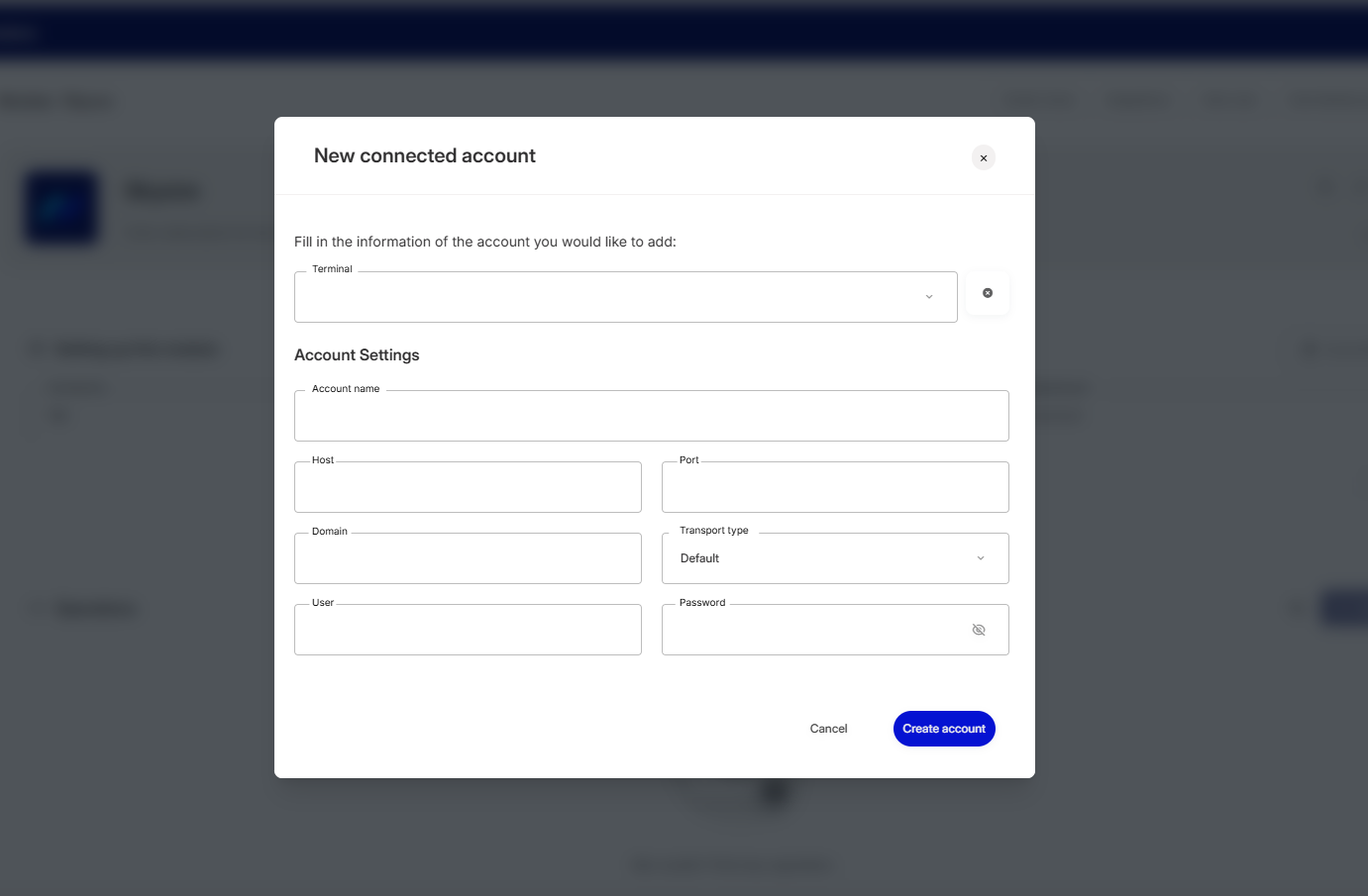
When you choose the "**Add connected account"** option, the following modal will be displayed:
Fill in the details:
1. **Terminal (optional):** if you have a terminal set up, select it so that the connection is made through the corresponding "**Agent**";
2. **Account name:** name of the registered account;
3. **Host:** IP of the database host;
4. **Port:** port number;
5. **Domain** (optional);
6. **Transport type** (optional): choose between Default, Net Bios Over TCP and Direct TCP Transport;
7. **User;**
8. **Password;**
After filling in the details, click on "**Create account**".
That's it! Your connected account has been created and can be used by other modules and flows, appearing among the options of accounts configured in both cases.
{% endtab %}
{% endtabs %}
Finally, click on "**Save changes"** to configure your module settings.
{% hint style="warning" %}
Important: after saving the changes, it will no longer be possible to change the Connectivity type and/or Authentication type (Database).
{% endhint %}
Next step: [Create operations for the module](/english/skyone-studio/modules/settings-and-operations/operations.md)
Read also: [Connected accounts management](/english/skyone-studio/modules/settings-and-operations/module-settings/connected-account-management.md)
---
# Agent Instructions
This documentation is published with GitBook. GitBook is the documentation platform designed so that both humans and AI agents can read, navigate, and reason over technical content effectively. Learn more at gitbook.com.
## Querying This Documentation
If you need additional information that is not directly available in this page, you can query the documentation by asking a question.
Perform an HTTP GET request on the following URL with the `ask` and `goal` query parameters:
```
GET https://docs.skyone.cloud/english/skyone-studio/modules/settings-and-operations/module-settings/connectivity-file.md?ask=&goal=
```
`ask` is the immediate question: it should be specific, self-contained, and written in natural language.
`goal` is what the user is ultimately trying to achieve, the reason they need the answer. Sharing it helps GitBook give you a better, more relevant answer. A goal is most helpful when it describes the outcome the user wants rather than restating the question. For example, with `ask=how do I create an API token`, a goal like `automate deployments from our CI pipeline` lets GitBook tailor the answer to that use case.
The response will contain a direct answer to the question and relevant excerpts and sources from the documentation.
Use this mechanism when the answer is not explicitly present in the current page, you need clarification or additional context, or you want to retrieve related documentation sections.